Tuesday, June 21, 2011

Lizzie Bright and the Buckminster Boy by Gary D. Schmidt

Genre - Historical Fiction

Rating - 4.5/5

Age group recommendation - Grades 5-12

The Scoop -
When Turner Buckminster moves from Boston to Maine, he discovers a new way to play baseball, friends in unlikely places and how hard growing up can be. Turner causes controversy in the town with his friendship with Malanga Isaland resident Lizzie and changes the course of the entire town.  

The Story -
I enjoyed reading this book.  Even though the story is set in a different time period, I don't think that would keep readers from connecting with the story.  The characters are vibrant and believable and the action of the story keeps the reader's interest.  Toward the beginning of the book, it felt like it was going to be a "boy" book, focusing on baseball and the interests of a young boy.  But, with the introduction of Lizzie and her friendship with Turner, the story takes a turn that makes it an "everybody" book.  Turner's relationship with his father has a lot of conflict and could be another point of connection for young readers.  Even though the ending is sad, with a lot of death, the lessons of people making the right choices helps even out the sadness.

Educational applications
Georgia Performance Standards 
ELA6R1 The student demonstrates comprehension and shows evidence of a warranted and responsible explanation of a variety of literary and informational texts.

Working in collaboration with the classroom teacher, students are instructed to use the text as a basis for finding the factual events that happened at the time in which the story is set.  Students should look for events described in the book (the destruction of the Malanga Island community) and events that have similar conflicts (e.g. characters vs. society). Students use a variety of research methods including online journals and archives and the school OPAC for other historical and fictional sources.

 
Lizzie Bright and the Buckminster Boy by Gary D. Schmidt 

 New York : Clarion Books, c2004
Copy from Atlanta Fulton County Library

Monday, June 20, 2011

Max's Words by Kate Banks

Genre - Fiction

Rating - 5/5

Age group recommendation - K-3

The Scoop -
Brothers Karl and Benjamin collect coins and stamps, but when Max shows what he can do with the words he collects, his brothers join the fun!

The Story -
It must be the writer in me that loves this book.  The book presents writing in its simplest form - putting one word after another.  I think this book could assuage fears many students have about writing.  If they look at writing as a smaller task like putting one word after another rather than completing several paragraphs it could be a lot easier for students to tackle.

Educational applications  


Georgia Performance Standards 
ELA3R2 The student acquires and uses grade-level words to communicate effectively. 
ELA3C1 The student demonstrates understanding and control of the rules of the English language, realizing that usage involves the appropriate application of conventions and grammar in both written and spoken formats. 
  
Any set of vocabulary words could be used for any grade with this book.  For third grade, the teacher and media specialist work collaboratively to introduce the book and the concept of word placement.  A variety of vocabulary and other words are written on index cards.  Each student is given seven cards with a mixture of types of words.  Students may trade cards, but must be sure to have a mixture of words that will form a correct sentence.  Students present their sentences to the class and explain what part of speech each word is.  Students could also be put in groups to create several related sentences. 

Max's Words by Kate Banks Illustrated by Boris Kulikov
New York : Farrar, Straus and Giroux, c2006
Copy from Atlanta Fulton County Library

Thursday, June 16, 2011

Saving the Griffin by Kristen Wilden Nitz

Genre - Fiction

Rating - 4/5

Age group recommendation - Grades 3-6

The Scoop -
When Kate and Michael find a baby griffin outside their Italian vacation villa, they vow to return Grifinino to his home and to keep his existence a secret.

The Story -
Technically, this may not be a historical fiction book, but it does have some historical aspects with the setting in Italy and the appearance of the griffin.  This is a fun story especially for those who are interested in the Harry Potter series.  I would recommend this to students who are below the Harry Potter reading level, but still really want to read that type of book.  The plot is simple to follow and the themes are easy for a younger audience to identify with.  This book would be great practice before moving on to something more complicated.

Educational applications  
 
Georgia Performance Standards 
ELA5W2 The student demonstrates competence in a variety of genres.
 
Katie and Michael learned very quickly how to tell if what they had found was a griffin or not.  Students should imagine that they have found a mythological creature in their backyard.  The student must now educated their family on the characteristics of the creature and explain how they identified the creature.  Students write an informational brochure about a mythological creature of their choice.  Students should use print and online sources for their information.

Saving the Griffin by Kristen Wilden Nitz
Atlanta, Ga. : Peachtree, c2007
Copy from Atlanta Fulton County Library

Wednesday, June 15, 2011

The Puzzling World of Winston Breen by Eric Berlin

Genre - Fiction (Tween)

Rating - 5/5

Age group recommendation - Grades 3-6

The Scoop -
Winston Breen sees puzzles everywhere, in everything.  When Winston buys an antique box for his sister for her birthday, he has no idea that the puzzles pieces hidden in the secret compartment will lead him to solve a twenty-five year old puzzle.

The Story -
This book is a lot of fun. The story is interesting in several different ways - the mystery of the puzzle pieces, the mystery of the treasure hunters and other characters involved in the hunt, and the puzzles Winston creates for the reader to solve.  The plot always moves the story in a very natural way.  Even though puzzles unrelated to the overall story are interspersed throughout the text, the puzzles never detract from the pacing of the book.  In fact, the break of the puzzles tends to heighten the tension related to the mystery.   If this were part of my collection, I would keep copies of the puzzles in the book to give to students who check out the book.

Educational applications 


Georgia Performance Standards 
ELA4W2 The student demonstrates competence in a variety of genres.
ELA4LSV2 The student listens to and views various forms of text and media in
order to gather and share information, persuade others, and express and understand ideas.

ELA4C1 The student demonstrates understanding and control of the rules of
the English language, realizing that usage involves the appropriate application
of conventions and grammar in both written and spoken formats.

ELA4W3 The student uses research and technology to support writing. 
Working collaboratively with the classroom teacher, the media specialist introduces the students to the genre of mystery prior to reading the book or excerpts from the book.  They are given a list of questions to think about while reading -
* What do you think a mystery should be?
* When you think about mysteries, what comes to mind?
* What is your favorite mystery book, movie, or TV program?
* What do you find suspenseful?
* How did the author make you curious?
* What do you think makes a good mystery?

After reading, students are asked to create their own mystery story using the information from their answers to the questions.  Students may also use web sites to research further ideas like Mystery Net Kid's Mysteries.  Student may work individually or in assigned groups.


The Puzzling World of Winston Breen by Eric Berlin
New York : Putnam, 2007
Copy from Atlanta Fulton County Library

Tuesday, June 14, 2011

Creative Shelving

I'm not talking about genre shelving or even color coding.  I've come across a few Do-It-Yourself (DIY) ideas for creating shelving at very low cost.  Just get your elbow grease ready!

These bookshelf ideas are best for a reading area, rather than for additional room in your stacks.

Ever seen stacks of pallets behind a store? Those a just waiting to be remade into something completely different from their intended purpose!  Little Lucy Lu gives a step-by-step tutorial on how to transform an old pallet into cute shelving.   The results are great!


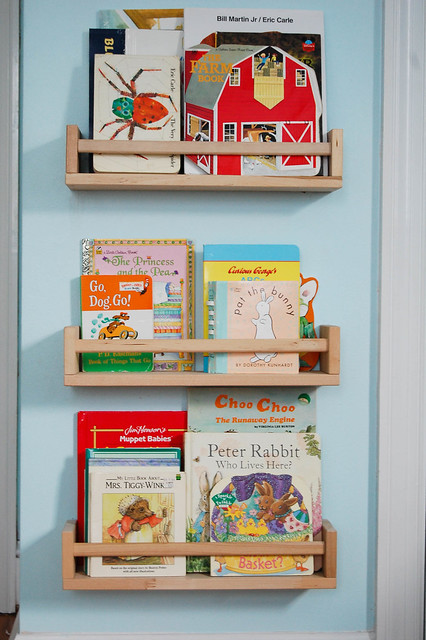
A similar idea with less DIY is using Ikea spice racks as book shelving.  The racks are inexpensive and can be painted any color you like. Domestic Simplicity has a great and accessible display of classic books.


What would you do with some rain gutters? Clean ones, of course!  As very clever person decided to use gutters as shelving for her children's school room (via odeedoh).  You wouldn't need one huge wall for this to work in your space.  A smaller length of gutter could easily be used on a smaller wall.

Monday, June 13, 2011

We Tell Stories

We Tell Stories is a website that features digital fiction from Penguin.  Each of the six stories is formatted in an innovative way.

"The 21 Steps" follows a character through a journey on Google Maps and includes points of interest along the way.

"Slice" follows Lisa through a family move to London via her personal blog posts and Tweets as well as her parents' blog and Tweets.

Other formats for the stories include choose your own adventure, writing in real time, and telling a non-fiction story through graphic means. Any of these digital stories would make a great template for a class project.  English, history, geography, science...the options are unlimited!

"The 21 Steps" is especially adaptable to many different subject areas.  Using Google Maps or any other mapping software, students can create a digital tour of their city, state, or the country highlighting historical sites, geographical places of interest, or literary sites.  Science classes could use this idea to map butterfly or bird migration, map constellations with Google Sky

We Tell Stories was awarded Best in Show at the South by Southwest Web Awards in 2008 (BBC article).

Wednesday, June 1, 2011

Feed by M.T. Anderson

Genre - Science fiction

Rating - 4/5

Age group recommendation - Grades 11-12
 
The Scoop - In a futuristic world where most people have computer implants in their heads to access information, a boy named Titus meets an unusual girl on the moon who changes his life.

The Story - In this future world, corporations run everything including the Feed, the constant stream of data each person experiences through their implants. Titus and his friends have always had their Feeds and attend School, Inc.  Violet got her feed when she was older than most and is home schooled.  Because of the late addition of the Feed to Violet's brain, she begins to have physical problems.  

I listened to the audio version of this book.  When it first began, I wasn't sure if I would make it through the whole thing!  Anderson writes the language of teenagers  perfectly and David Aaron Baker, the voice artist, performs the text amazingly. To give you an idea of the teen speak in this book, this is a world where even the parents say things like "Dude, you like, totally need to listen right now, dude." Additionally, the audio version contains ads that would be playing on Titus' or other characters' Feeds; it is a very effective device for the story, especially in audio format.  At times I felt completely bombarded with ads and TV shows.

The story in the midst of all the media is a really good one. Titus is attracted to Violet because she is different from anyone he's met before.  She sees the world differently and comes from a very different socio-economic background.  Violet encourages Titus to see beyond the constant stimulus of the Feed or to at least think about what he's being exposed to. 


Educational applications 


Feed addresses so many things that are regular parts of many students' lives - technology overload, fitting in (or not) with a group, consumer culture, and first love. This novel would be a great companion to a sociology lesson or as an example for writing interestingly about social and cultural issues.

Feed by M.T. Anderson
New York : Random House Listening Library, 2002
Copy from Dekalb County Library